About

Practical AI systems for real work.

Saalik Systems exists to help businesses use AI without losing control of the work around it.

We design, build, and improve AI-supported systems around real workflows, real responsibilities, and real people.

The goal is simple:

Make AI useful where the work actually happens.

Why Saalik Systems exists

AI can do a lot.

That does not automatically make it useful.

A powerful model can still sit inside a bad workflow.

A clever assistant can still create more work than it removes.

An automation can still fail because nobody clearly defined what it was responsible for.

Saalik Systems was built around a different starting point:

Understand the work first.

Then decide what technology belongs in it.

System first. Tool second.

Jamaal Saalik
Belt-Daniels
Founder, Saalik Systems

Built from an operator's perspective

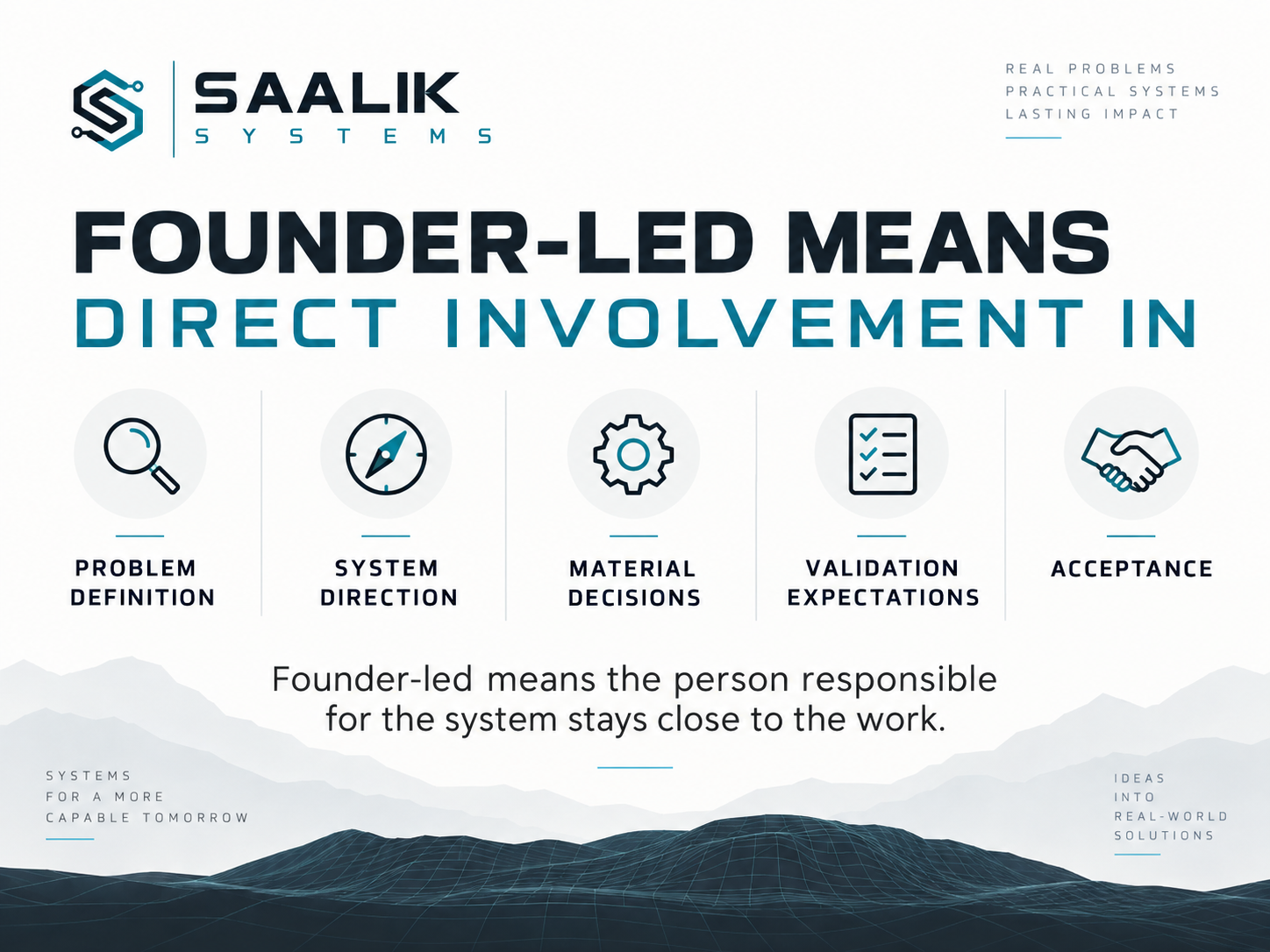
Founder-led by Jamaal Saalik Belt-Daniels.

The company was not built from the perspective of someone trying to find places to insert AI.

It was built from the perspective of someone used to solving real operational problems.

That matters.

In real work, a system does not get credit for being impressive.

It has to help people do the job.

It has to make sense when conditions change.

It has to be understandable enough to use, manage, improve, and hand off.

And when something matters, somebody still has to be responsible for the decision.

That operator mindset shapes how Saalik Systems approaches AI.

That background matters because real work is messy.

People inherit broken processes. Tools get added before the workflow is clear. Decisions move faster than documentation. Systems have to survive handoffs, interruptions, changing conditions, and imperfect information.

Saalik Systems was built for that reality.

We build around the job.

A Saalik project starts with questions like:

  • What are you actually trying to accomplish?
  • Where is the current work getting harder than it needs to be?
  • What should AI handle?
  • What should a person still decide?
  • What information does the system need?
  • What happens when the normal path breaks?
  • How will somebody understand this later?

Those questions are usually more important than which model or platform gets chosen first.

Technology matters.

But the system around it matters too.

Control does not have to mean complexity.

Control should be proportional to consequence.

Some work needs strong boundaries, review, validation, and human decision points.

Other work should stay lightweight.

The goal is not to wrap every AI task in unnecessary process.

The goal is to give the work enough structure that the system can be useful without becoming another thing people constantly have to babysit.

Good structure protects the output.

It also protects your attention.

We design. We build. We fix.

Three main service paths.

01

Review & Design

Understand the problem and define the right approach before unnecessary work gets built.

02

Implementation

Turn a clear need into a working assistant, workflow, internal tool, application, automation, or other AI-supported system.

03

Recovery & Improvement

Take existing AI work that has become messy, inconsistent, difficult to manage, or hard to continue and create a cleaner path forward.

Explore Services

Proof that we build.

Live, bounded systems.

Saalik Systems does not only describe what bounded AI systems could look like.

We build them.

Our public Live Demos include three AI agents created for Governed Context Architecture:

  • GCA Planner
  • GCA Controlled Document Builder
  • GCA Auditor

Each has a specific responsibility, a clear role, and defined limits.

You can use them yourself.

Explore Live Demos

A practical relationship with governance

The method should support the work—not become the work.

Saalik Systems is informed by Governed Context Architecture, a separate body of work focused on structure, control, continuity, and authority in AI-assisted systems.

That work influences how Saalik Systems thinks about boundaries, human authority, validation, system roles, and continuity.

But clients do not need to become governance experts.

The method is there to make the implementation better.

Explore the Method

The external GCA site link will be added when its verified public URL is supplied.

What we believe

AI should support the work, not quietly take ownership of it.

A useful system should have a clear job.

People should know when they are expected to take over.

The amount of control should match the consequences.

A working implementation should remain understandable after the original build is finished.

And technology should earn its place in the workflow.

No uncontrolled implementations.

Practical systems. Real work.

Saalik Systems is building for the point where AI stops being an experiment and starts becoming part of how work actually gets done.

That is where structure matters.

That is where implementation matters.

And that is where Saalik Systems works.

What are you trying to build, fix, or make easier?

Start with the problem.

You do not need to arrive with a technical specification.

We can figure out the rest from there.