Method

Build the system around the work.

Not the other way around.

Saalik Systems uses a structured approach to AI implementation so the technology fits the job, the people using it, and the consequences of getting it wrong.

The goal is not to add more process.

The goal is to build something useful without losing control of how the work gets done.

System first. Tool second.

Start with the problem.

AI is not the starting point.

The work is.

Before deciding what model, platform, automation, or application to use, we start by understanding what is actually happening:

  • What are you trying to accomplish?
  • Who is doing the work?
  • Where does the current process break down?
  • What information does the system need?
  • What decisions still belong to people?
  • What would a useful result actually look like?

Sometimes the answer is an AI system.

Sometimes it isn't.

The method is designed to figure that out before unnecessary complexity gets built.

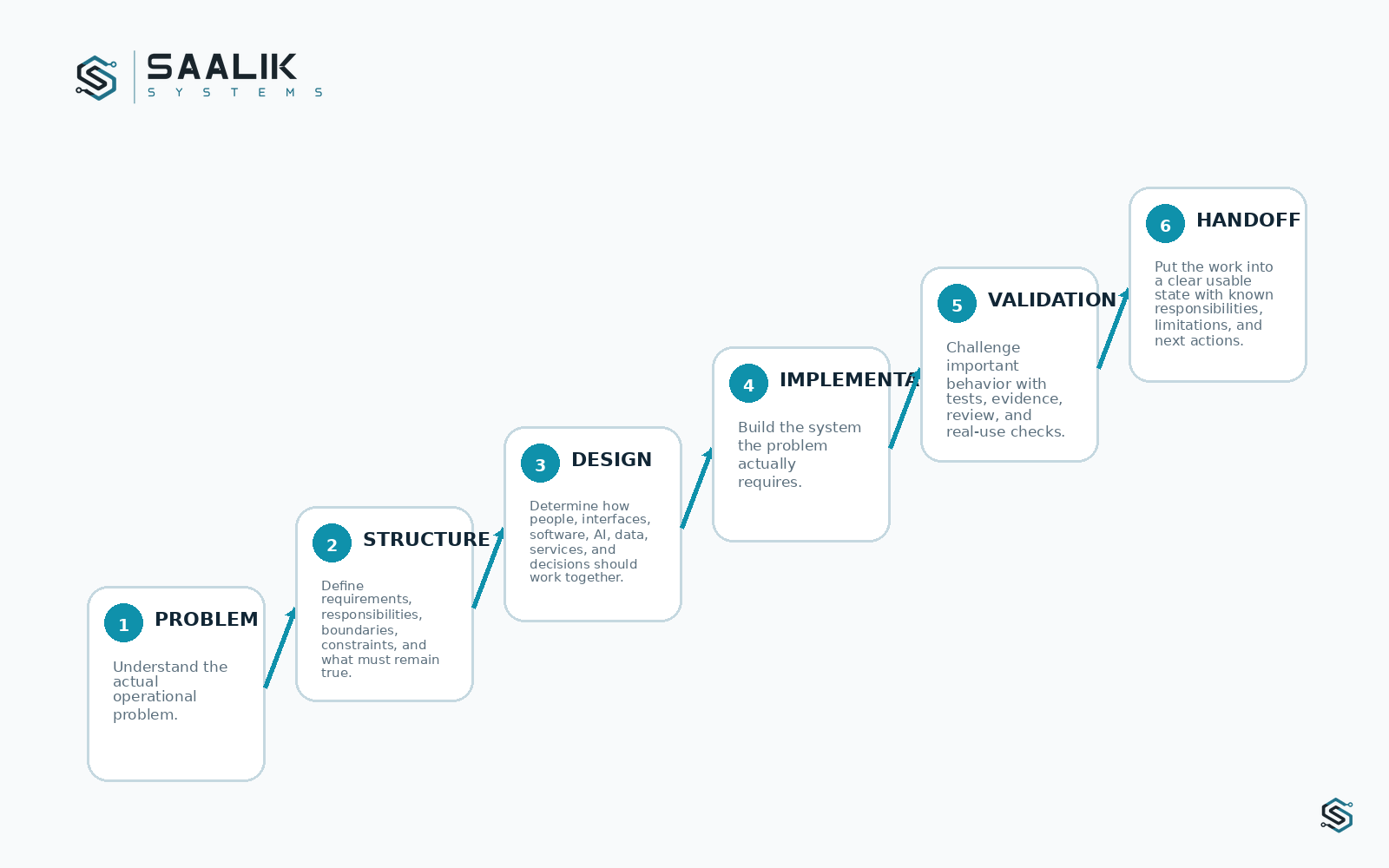
From problem to working system

01

Problem

Understand the real job.

We define what needs to improve, who the system is for, and what success should look like. The purpose of this stage is simple: Make sure we're solving the right problem.

02

Structure

Give the work a clear shape.

Before building, we identify the important roles, information, decisions, boundaries, and handoffs around the work. This is where a vague idea starts becoming a system that can actually be designed.

03

Design

Decide how the system should behave.

We work out what the AI should do, what it should not do, what inputs it needs, what outputs are useful, and where human judgment needs to remain involved. The design should fit the work—not force the work to fit the technology.

04

Implementation

Build what the job actually needs.

That may be an assistant, workflow, internal tool, application, automation, or a combination of systems. The implementation is built from the defined problem and design rather than from a vague instruction to "add AI."

05

Validation

Make sure it works where it matters.

A system is not finished just because it produces an output. We look at whether it behaves as expected, supports the actual workflow, handles important edge cases, and gives people enough visibility and control to use it responsibly. Problems found here get fixed, narrowed, or scoped before the system is treated as finished.

06

Handoff

Leave behind something that can be understood and used.

The people receiving the system should know what it does, how it is intended to be used, where its limits are, and what to do when something changes. A useful implementation should not depend on the original builder being permanently present just to keep it understandable.

Principle 01

Control proportional to consequence

Not every AI task needs the same amount of control.

A system helping brainstorm marketing ideas does not carry the same consequences as one used around financial, legal, safety, operational, or customer-facing decisions. Saalik Systems adjusts the amount of structure, review, and human involvement to the consequences of the work. Higher consequence means stronger control. Lower consequence work can stay lighter. The point is not maximum governance everywhere. The point is the right amount of control for the job.

Principle 02

Good structure gives you attention back.

AI governance should not exist just to create more rules.

It should make the system easier to trust, understand, and manage. Clear roles, boundaries, review points, and decision ownership reduce the amount of time people have to spend checking whether the AI has wandered away from the job it was supposed to do. Good governance protects the output. It also protects your attention.

Principle 03

Clear roles make better systems.

What is this AI responsible for?

One of the easiest ways for AI systems to become difficult to manage is to give one system too many responsibilities. Planning, building, reviewing, approving, and deciding are not automatically the same job. When those responsibilities matter, separating them can create clearer behavior and better human oversight. That does not mean every project needs multiple agents or a complicated architecture. It means the system should have a clear answer to a basic question.

Principle 04

Humans keep the authority that matters.

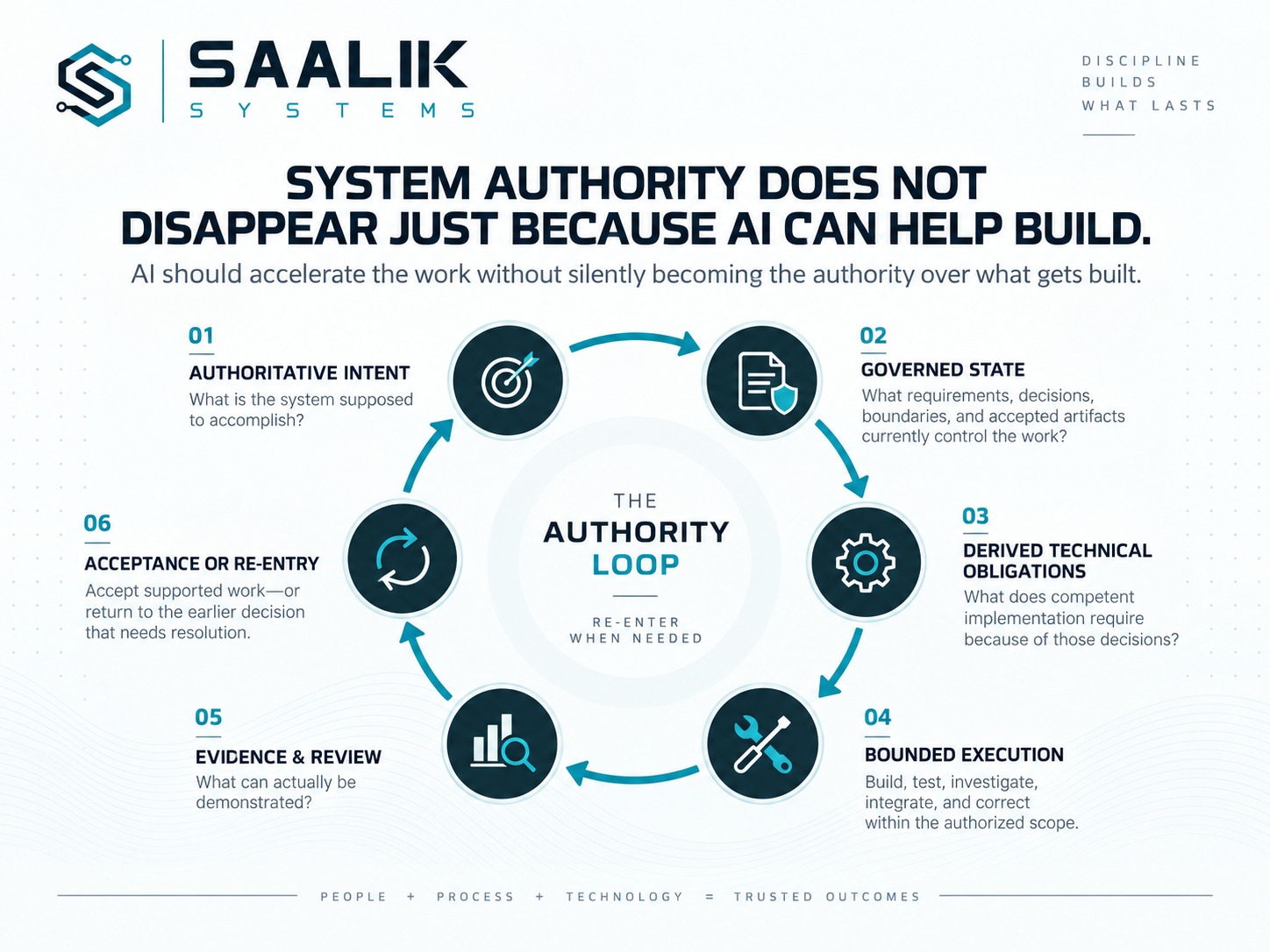
AI output should support the work. It should not quietly authorize itself.

AI can support analysis, drafting, organization, recommendations, automation, and execution. That does not mean the AI should automatically become the final authority over the work. Where judgment, approval, accountability, or consequence matters, those responsibilities should remain clearly assigned.

Principle 05

No uncontrolled implementations.

Saalik Systems does not treat 'it works most of the time' as the only requirement for putting AI into real work.

The amount of control will vary from project to project, but the basic expectation stays the same: We should be able to explain what the system is supposed to do, where its boundaries are, and who remains responsible for the important decisions.

Method-informed by Governed Context Architecture

Applied practically.

Saalik Systems is informed by Governed Context Architecture, a separate body of work focused on structure, control, continuity, and authority in AI-assisted systems.

GCA shapes how Saalik Systems thinks about things like:

  • Clear system roles
  • Defined boundaries
  • Human authority
  • Review and validation
  • Continuity across complex AI work
  • Keeping systems understandable as they grow

Saalik Systems applies those ideas practically.

You do not need to learn GCA or adopt a formal governance framework to work with Saalik Systems.

The method is there to support the work—not become the work.

The external GCA site link will be added when its verified public URL is supplied.

Explore Live Demos

What does your work actually need?

Start with the problem.

You do not need to arrive with a finished technical plan.

We can figure out the structure from there.