Start with the problem. Build only what the work requires.
You do not need to know whether the answer is an application, AI system, workflow, automation, integration, or something else.
Tell us what happens now, what needs to happen instead, and where the work is getting stuck.
From there, the work generally follows one of three paths.
REVIEW & DESIGN
Figure out what should actually be built.
This is the place to start when the problem is real but the solution is not fully defined.
That may mean a process is too manual, information keeps getting lost, tools do not work together, an AI workflow behaves inconsistently, or you simply know there should be a better way to do the work.
We turn that operating problem into a buildable system definition.
REVIEW & DESIGN CAN ESTABLISH
- requirements;
- workflow and decision rules;
- responsibilities and human review points;
- data and state needs;
- AI and automation boundaries;
- architecture direction;
- implementation priorities.
The goal is not to force more software into the business.
The goal is to determine what the work actually requires.
IMPLEMENTATION
Build the system.
Once the problem is sufficiently clear, Saalik Systems can carry it into implementation.
That may include applications, AI-assisted workflows, internal tools, structured intake, automation, backend services, persistent state, integrations, notifications, or a focused combination of those pieces.
The system should match the problem—not the other way around.
IMPLEMENT WITH INTENT
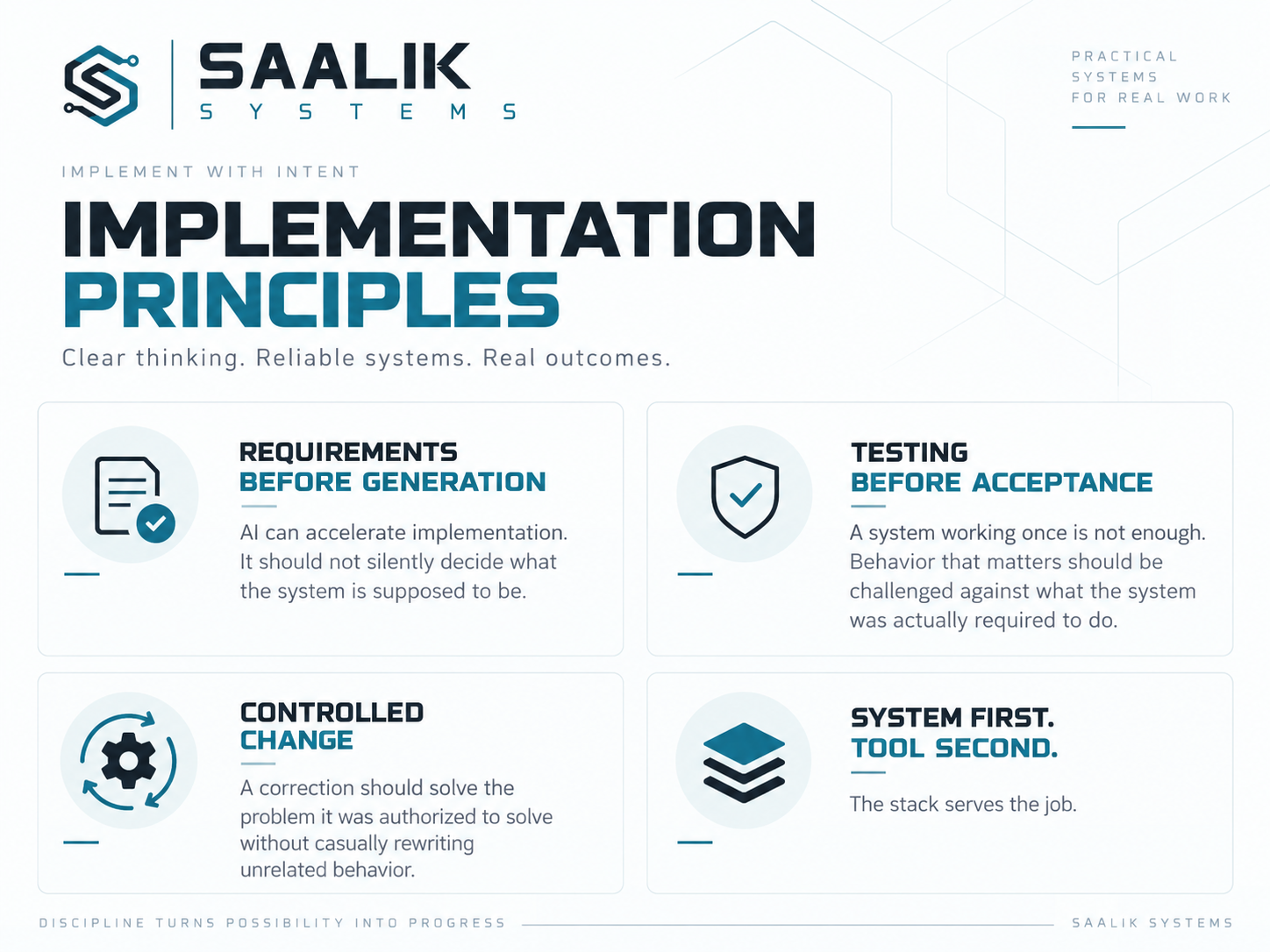
Those principles keep implementation tied to requirements, tested behavior, controlled change, and the job the system actually needs to perform.
Architecture should be proportionate too.
A focused system may be deliberately small. A larger product may need deeper state, recovery, and service boundaries.
Both are valid when they fit the work.
RECOVERY & IMPROVEMENT
Fix what exists without losing what still works.
Recovery is for systems that already exist but have become difficult to trust, change, or continue.
That may mean:
- too many competing versions;
- requirements and implementation no longer agree;
- AI-generated changes accumulated;
- part of the system works while another part fails;
- each attempted fix creates new problems.
The first job is not to start changing things.
It is to establish the real state of the system.
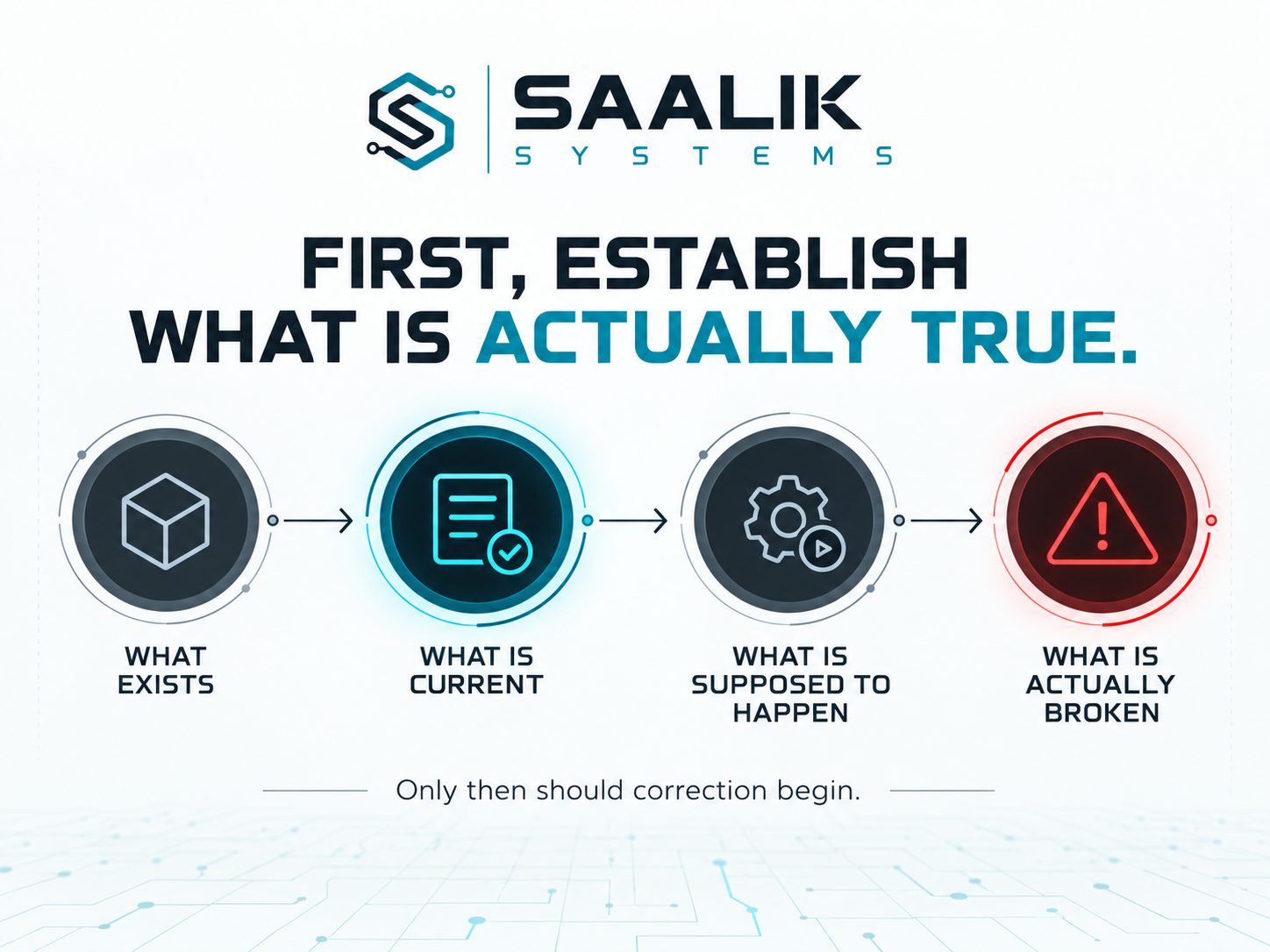
From there, recovery can focus on the actual break: reconstructing state, tracing behavior, reconciling requirements, diagnosing boundaries, making targeted repairs, and verifying that the correction did not damage what already worked.
Do not rebuild what does not need rebuilding.
HOW THE WORK CAN MOVE
A project does not need to follow a rigid delivery script.
The path should fit the work.
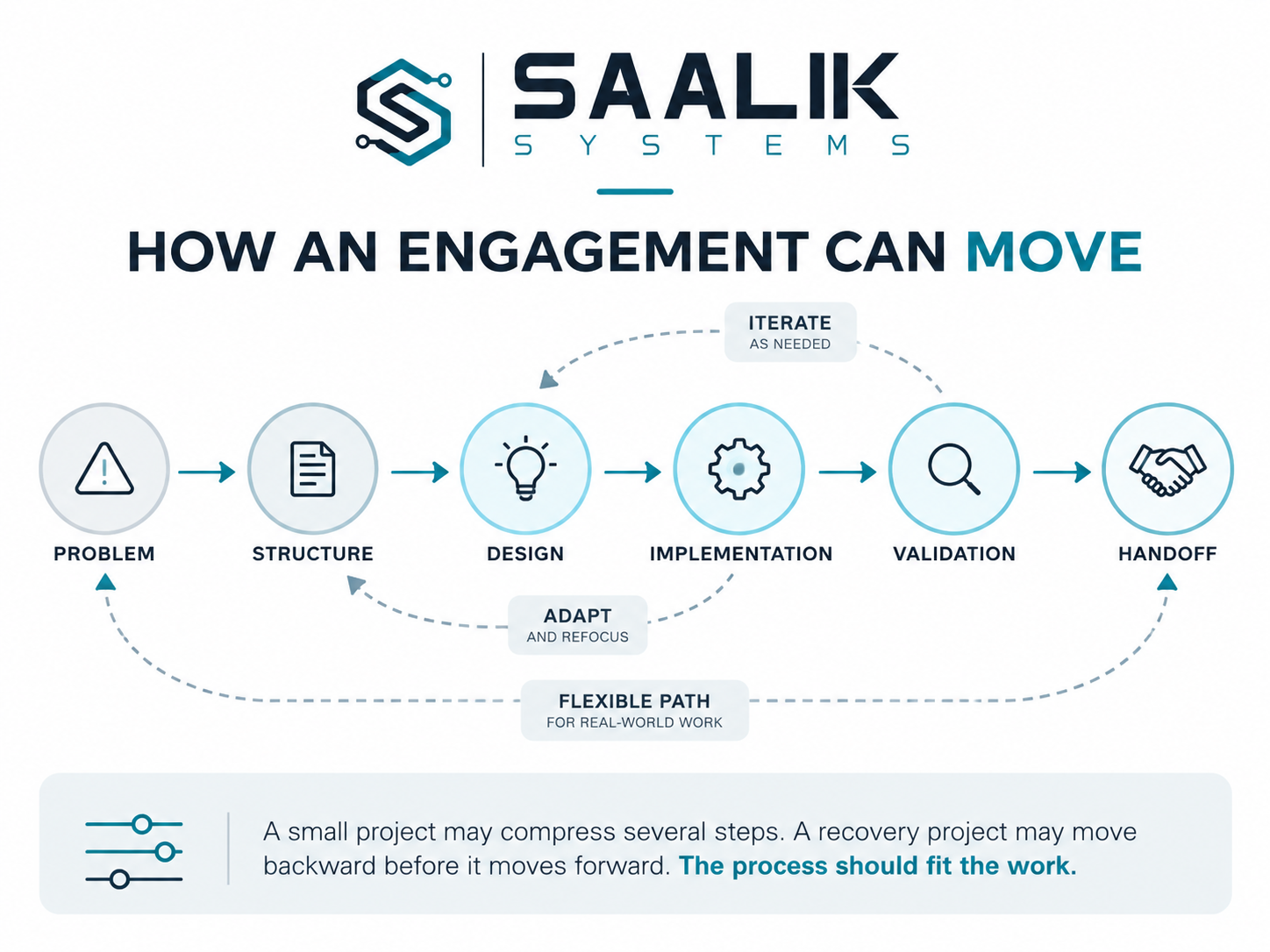
A small build may compress several stages. A recovery project may need to move backward before it can move forward.
The objective is a usable, tested system—not ceremony for its own sake.
NOT SURE WHICH SERVICE FITS?
You do not need to choose perfectly before contacting us.
If something needs to be built, repaired, connected, simplified, or made more reliable, start with the problem.
We can determine the right path from there.